
AI: What's Next Is Now
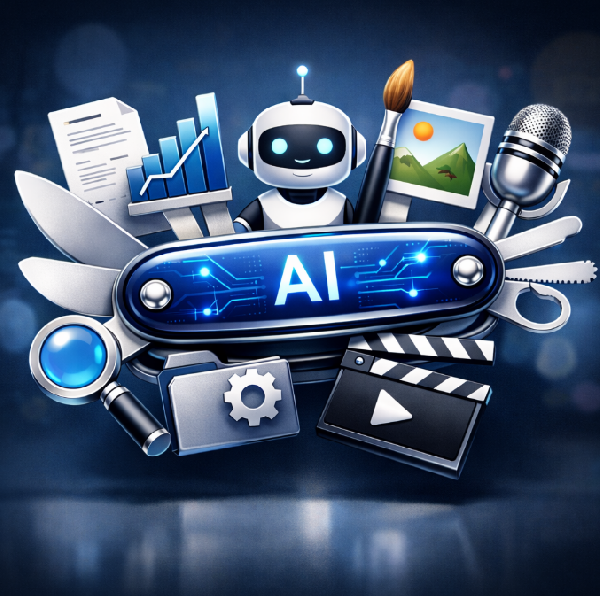 I'm asked all the time, "What's next with AI?"
If you're asking the question, you're probably at least a casual user, and you may have ideas of your own. In all likelihood, your ideas of AI evolutionary advancement are spot on, but what you may not know is that they're already here.
Yesterday, I delivered a presentation on ChatGPT 5.2. Literally, as I was running through my dress rehearsal the day before, Open AI, who owns ChatGPT, began rolling out model 5.3.
Everyone familiar with ChatGPT and other large language models is aware that the next version is always around the corner. They include both new applications and significant improvements to existing ones.
So, the answer to what's next with AI is, "What's next is now."
Let's explore what the AI landscape looks like at the moment.
AI Agents
Agents have been around for a couple of years, which in The Age of AI is like a decade.
Suffice to say, the performance of agents today is fathoms better.
A typical chatbot interaction starts with a prompt and ends with an answer. You ask a question, it responds, and the exchange is complete. For example, “Hey Mildred,”—that’s what I call my ChatGPT chatbot—”What are today’s top news headlines about AI regulations?”
AI agents operate differently. They are digital assistants and strategic thinking partners. Instead of producing a single response, they can carry out a series of steps to accomplish a broader task. An agent researches a topic, gathers and analyzes information, organizes the findings, and produces a structured output such as a report or summary.
For example, “Buenos dias, Mildred! Monitor news about AI regulations and send me a weekly summary with key implications for businesses.”
Then Mildred runs with it. You don’t have to start a new chat or reprompt it. The best part is that building an agent is much easier than it sounds. Just ask ChatGPT, Gemini, Claude, or whichever one you use to walk you through the steps.
Document and Data Analysis
AI interprets PDFs, spreadsheets, reports, and transcripts to extract insights, summarize information, and identify patterns.As one of the leading marketing software providers and thought leaders in the industry, I trust HubSpot.
They’re constantly publishing reports, and one I like to read is their annual Responsible Business Report. They are long, like 57 pages. First, I do my own scan, and then Mildred is summoned:
“And a good day to you, Mildred! Please do the following:
Summarize this report in three key insights for an executive audience.
- What is the most effective marketing channel in this report and why?
- Based on this report, what strategic recommendations would you give the leadership team?
- Rewrite this report as a one-page executive summary.
Multimodal AI Across Media Types
AI systems don’t do themselves any favors by presenting you with a standard chatbox.Users think they can only communicate through written prompts.
Au contraire!
Today’s models interpret and respond to multiple forms of input, including text, images, audio, and documents. A user might upload a chart, provide written context, and ask the AI to explain the data or summarize the insights.
In other situations, AI can transcribe spoken audio, analyze visual information, or combine several sources of input in a single task.
The Multimodal Mildred’s of the AI ecosystem give you the ability to work across different media types, allowing the technology to assist with a much wider range of activities.
Advanced Multimedia Creation
Mildred’s multimedia capabilities have progressed dramatically in a short period of time.
This is true for your Mildred and most other large language models.
Today’s platforms can generate sophisticated visuals, voice narration, and even video based on simple prompts. What once required specialized design or production tools can now be created in minutes.
Professionals—and people pretending to be professionals—are using these capabilities to develop presentation graphics, marketing visuals, diagrams, and other creative assets, turning AI into a powerful partner for both communication and content creation.
Deep Thinking Mode
AI can operate at two different speeds depending on the complexity of the task.
There’s Fast Thinking, which is like asking a co-worker down the hall a quick question that they answer off the top of their head.
“Preston, do you know when the Mongols ruled China?”
“From 1271 to 1368 AD. Idiot.”
Deep Thinking Mode, on the other hand, is similar to having an expert sit down with a whiteboard before revealing answers. Instead of a rapid response, it breaks the problem into parts, evaluates possible causes, and proposes a strategy.
“It’s me again, Mildred. A consulting firm wants to generate more leads from LinkedIn but their posts are getting very little engagement. Think through the possible reasons and recommend a strategy to improve their results.”
Deep Thinking gives you a comprehensive solution.
I’m sure by the time you read this, all of these applications will be entering their next generation.
It’s an AI world, and we’re just living in it.
About the Author, David Telisman

I am a Writer and Content Creator, and I work with businesses to inspire their customers to buy from them. I believe that my clients deserve to feel proud of how their content marketing looks and what it says, and I deliver by providing expert copywriting and marketing solutions.
Subscribe to our blog and YouTube channel, and follow us on Facebook and LinkedIn.
Mar 11, 2026 by
- share:


